Monitor readings guide
What does an indoor air-quality monitor actually measure?
A monitor measures signals, not causes. Aeroshi's current sensor records nine environmental channels every minute; the useful answer comes from how those signals change with room use, time, weather and a deliberate intervention.

The nine channels Aeroshi records
The current Aeroshi monitor uses a Sensirion SEN66 sensor core. Sensirion lists PM1, PM2.5, PM4, PM10, temperature, relative humidity, VOC Index, NOx Index and CO2 as its measurement outputs. See the manufacturer's SEN66 specification or the Aeroshi hardware appendix.
Ventilation context
CO2
People breathe out carbon dioxide. In a normally occupied room, its build-up and clearing pattern can provide broad context about air exchange.
Airborne particle mass
PM1, PM2.5, PM4 and PM10
Four size fractions help show particle events and whether filtration-related patterns change. PM2.5 is the primary fine-particle measure; the other sizes add source clues.
Moisture in context
Relative humidity
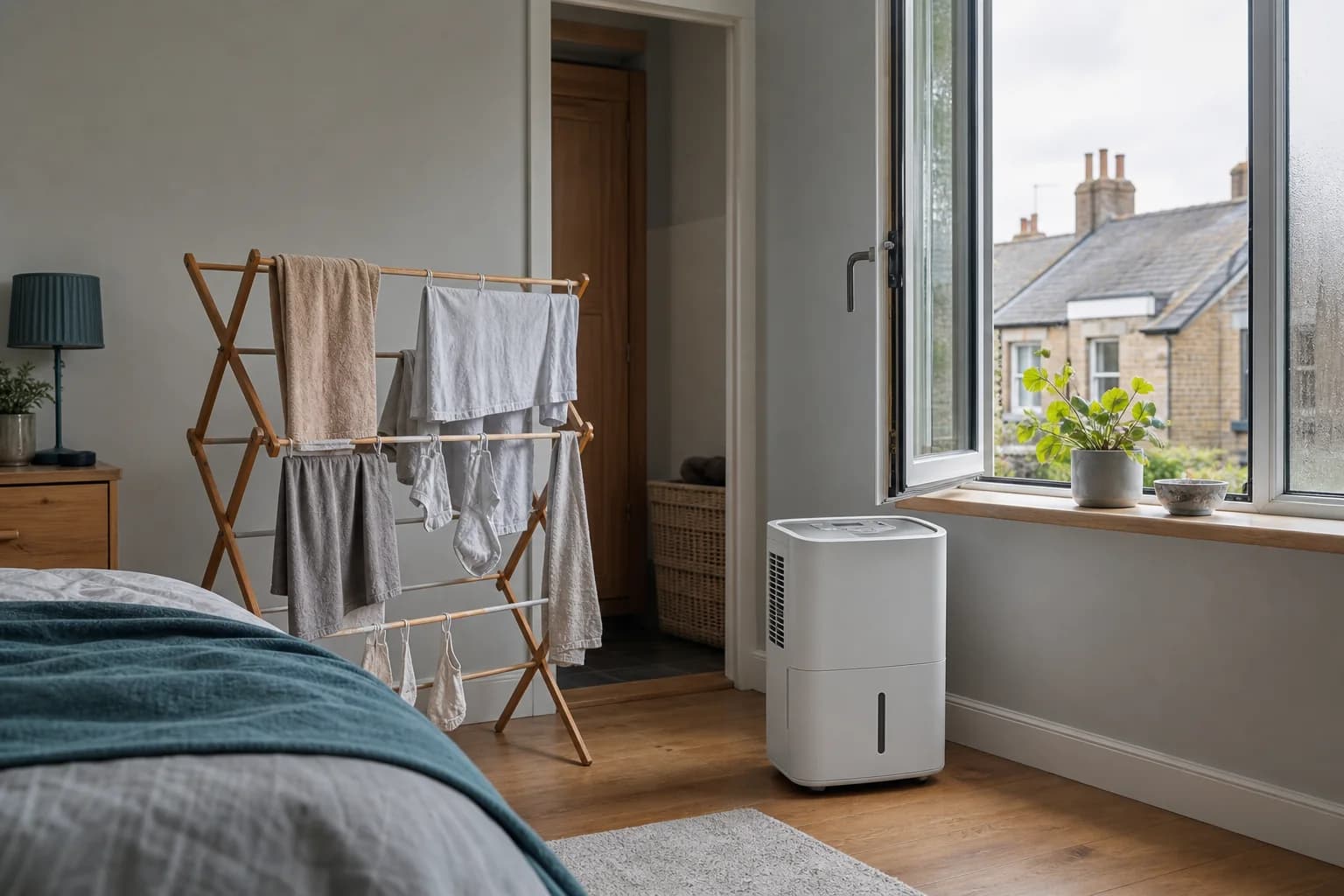
Shows how close the air is to saturation at its current temperature. The rise, duration and recovery after an activity matter more than one isolated percentage.
Comfort and condensation context
Temperature
Helps interpret relative humidity and whether a room or surface may be getting colder. It is not a measurement of hidden wall or fabric moisture.
Relative gas-source events
VOC index
Shows whether the mixture of volatile organic compounds is more or less intense than that room's recent history. It cannot identify an individual compound.
Relative nitrogen-oxide events
NOx index
Adds a relative clue for event-like nitrogen-oxide changes. It is not a regulatory-grade concentration measurement or a source diagnosis.
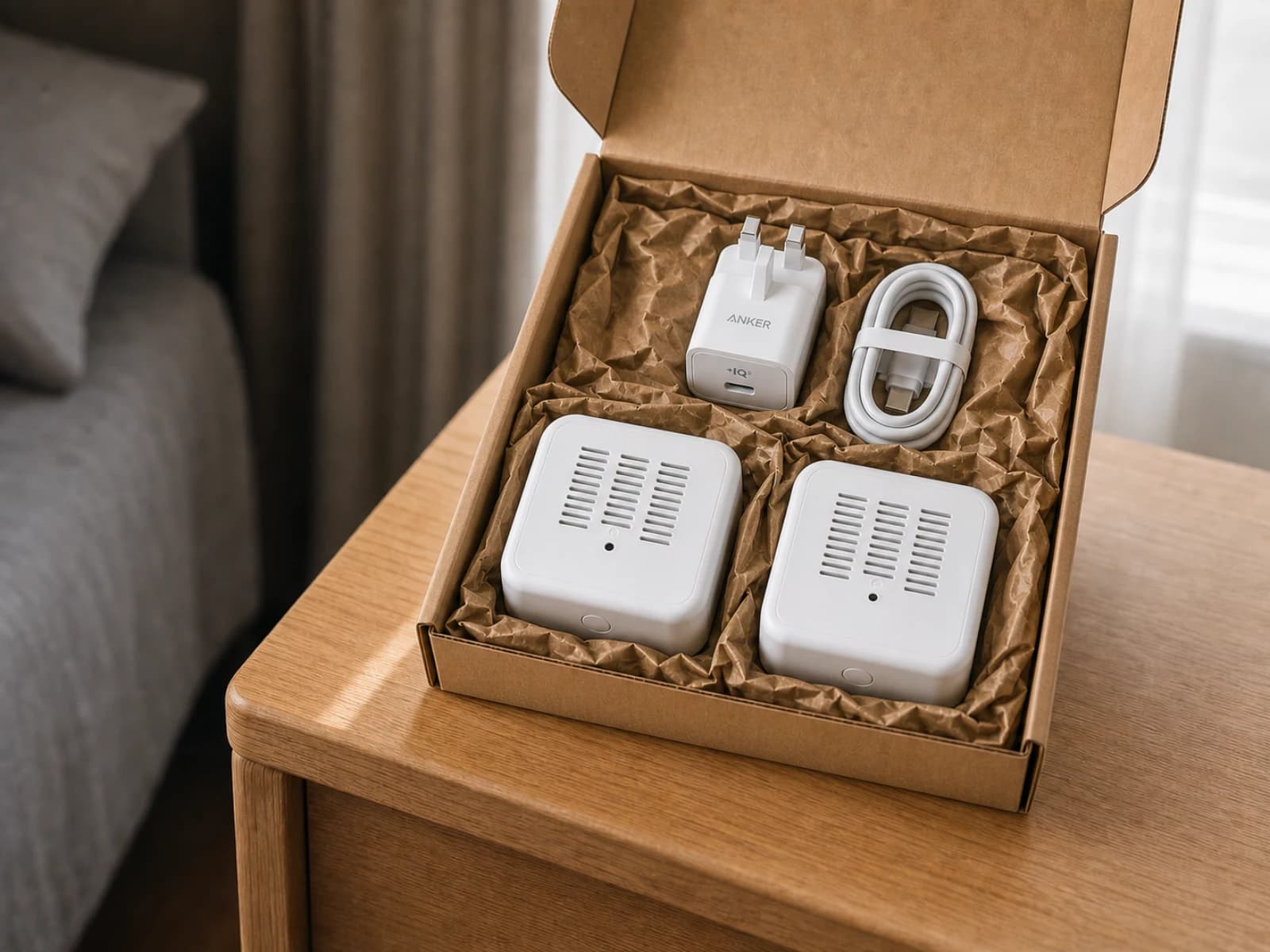
The current Home Air Check
Two identical monitors record the same nine channels in two rooms.
The useful difference is not a fancier reading. It is the room comparison, recurrence and before-and-after context around it.
Why VOC and NOx are called indices
These are relative signals, not a list of chemical concentrations. Sensirion explains that its VOC Index adapts to the room's recent history, with 100 representing the recent average. It can show that a gas event changed, but it cannot tell you which compound caused it. Read the manufacturer's VOC Index explanation.
What one reading cannot establish
- The source of a particle, VOC or NOx event.
- Whether a room is medically safe or caused a symptom.
- A formal ventilation rate, legal-compliance result or building defect.
- The presence of carbon monoxide, smoke, radon, mould spores or a particular allergen.
- Whether a brief peak is a recurring household pattern.
HSE guidance warns that snapshot CO2 readings can mislead and recommends representative placement plus repeated occupied-room measurements. Although written for workplaces, those measurement limits are useful in a home too. See the HSE CO2 monitor guidance.
What Aeroshi adds
The pattern around the number.
Two rooms provide context. Repeated days show whether the event returns. Activity and outside conditions help test plausible explanations. A before-and-after check then asks whether one practical change was followed by a meaningful difference.
See why two rooms are more useful than oneQuick answers
Questions people commonly ask
Does an indoor air-quality monitor measure carbon monoxide?
The Aeroshi monitor does not. CO2 and carbon monoxide are different gases. Keep suitable certified smoke and carbon-monoxide alarms installed, maintained and tested according to their instructions.
Can a VOC reading identify a particular chemical?
No. Aeroshi reports a relative VOC index that can reveal event-like changes from the room's recent pattern. It does not identify a compound or report a laboratory concentration for one chemical.
Can a monitor detect mould?
Not directly. Humidity and temperature patterns can add useful moisture context, but the monitor does not detect mould spores and cannot replace inspection or a professional damp and mould assessment.