01
Define the decision
Write down what will be decided from the result, which rooms matter and what change is expected.
A before-and-after result is useful only when the decision, baseline, intervention and comparison are defined clearly. This is a practical method for ventilation, filtration, retrofit and remedial work.
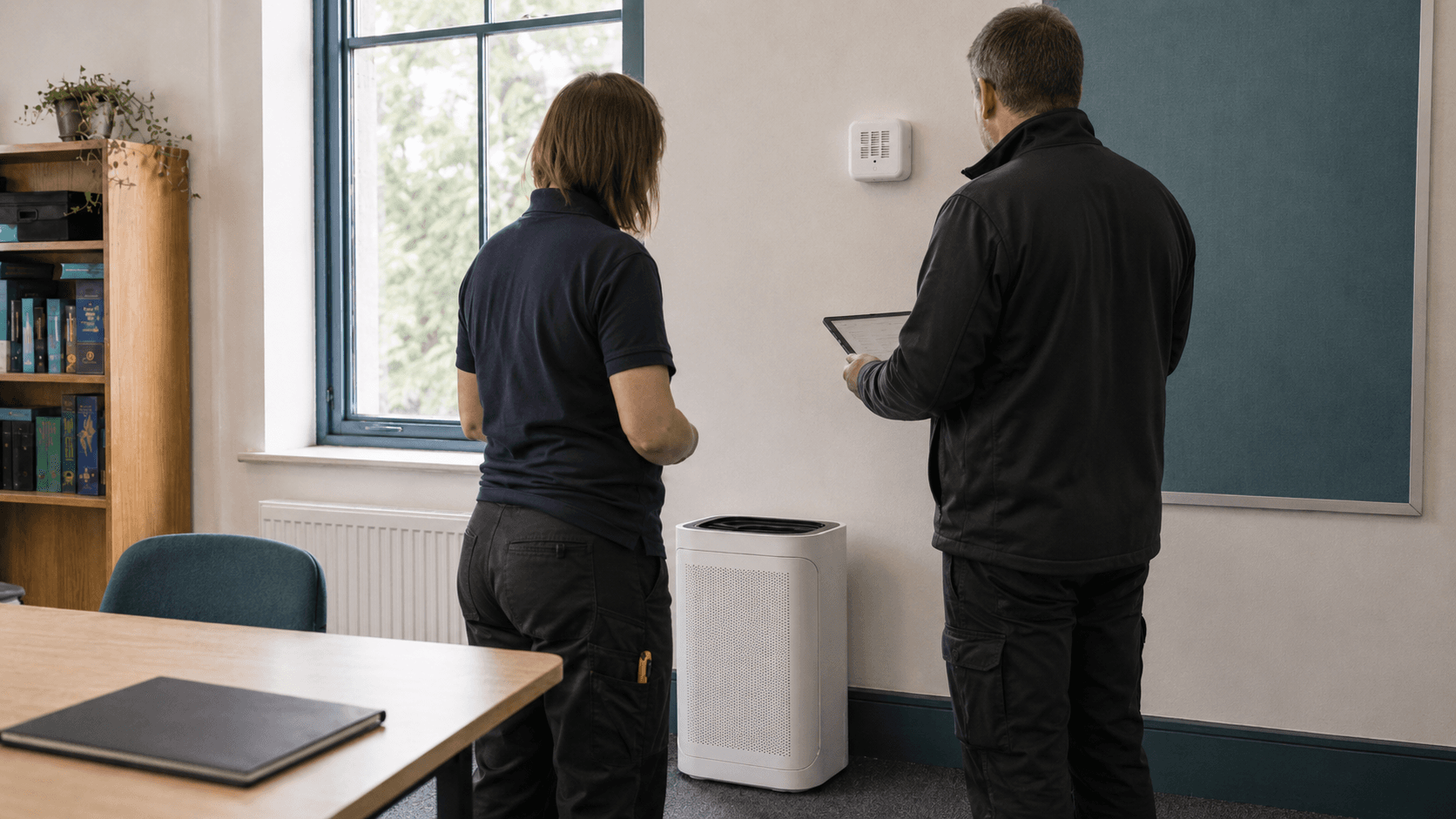
Start with the decision
“Did it work?” is too broad. Decide first whether the work is expected to reduce particles, improve occupied-room ventilation, stabilise moisture conditions or change another defined outcome.
Write down who will use the result and what they may do next. That choice determines the rooms, measures, monitoring window and level of certainty the study needs.
The method
Write down what will be decided from the result, which rooms matter and what change is expected.
Capture enough representative use to see the existing pattern, not just one convenient day.
Log the date, settings, rooms and operating changes precisely enough for the comparison to mean something.
Use consistent sensor placement and collect the same outcome measures after the work.
Review similar occupied periods, weather context, room use and any untreated comparison rooms available.
Report the observed change, the uncertainty and whether to retain, adjust, investigate or monitor again.
There is no universal monitoring duration. The window should be long enough to capture representative use and the pattern the intervention is expected to change. Plan it before the work wherever possible.
Choose the right evidence
| Intervention | Primary evidence | Context to record | Claim boundary |
|---|---|---|---|
| Ventilation or operating routine | Occupied-period CO₂ pattern, duration and room-clearing behaviour | Occupancy, doors and windows, system operation, temperature and outdoor conditions | CO₂ is ventilation and occupancy context; it is not a complete air-quality or safety measure. |
| Filtration or air purification | Particle levels, event frequency, duration and recovery | Equipment setting, room volume, indoor sources, outdoor particles and placement | Particle filtration should not be judged from CO₂, which most portable filters do not remove. |
| Damp, moisture or remedial work | Humidity and temperature recurrence, duration and recovery | Inspection findings, heating, ventilation, drying, weather and room use | Environmental monitoring can add context but does not diagnose the source of damp or mould by itself. |
| Retrofit or heating change | Room-level temperature, humidity and ventilation-context patterns | System schedule, occupancy, weather, room differences and the intended building outcome | A simple before-and-after comparison cannot automatically rule out seasonal or behavioural explanations. |
Compare responsibly
Weather, occupancy, source activity and equipment operation may all change between periods. Compare similar conditions, retain an untreated room where practical and document alternative explanations.
HM Treasury’s evaluation guidance recommends planning evaluation early, defining how an intervention is expected to work and using comparison evidence where feasible. A simple before-and-after design can show association, but it cannot by itself rule out another cause.
Observed change
This is the minimum defensible finding when the baseline, follow-up and data quality are clear.
Supported interpretation
Confidence improves when the timing, expected signal and comparison evidence align and alternatives are considered.
Causal conclusion
This needs a stronger design than a simple pre/post comparison. A comparison group or other robust method may be required.
Common weaknesses
A useful report
The expected measure improved repeatedly and the wider context supports the interpretation.
Some rooms, periods or measures improved while others still need attention.
The selected outcome did not materially improve, or natural variation was larger than the observed difference.
Coverage, comparability or context is too weak to make a responsible call.
Primary guidance
This guide explains a proportionate monitoring approach. It is not a substitute for competent ventilation, building, damp, occupational-hygiene, legal or clinical assessment where those are required.
Define the rooms, expected outcome, baseline, intervention date and decision audience. Aeroshi will suggest a proportionate starting scope.